
Grounding AI in the Physical World: The Next Frontier for Insurance

Enterprises across industries are struggling to realize meaningful value from AI adoption. In insurance, research from Boston Consulting Group suggests that AI can significantly improve the efficiency of complex insurance workflows, up to 36% in some cases. Today, much of this potential remains unrealized. While pilots often demonstrate value, they tend to remain isolated and siloed rather than evolving into repeatable, organization-wide capabilities.
As McKinsey has noted, increasing ROI from AI requires systems which are modular, reusable, and integrated into workflows from the outset, not one-off experiments. At a deeper level, this is not only a scaling problem. It is a coordination problem.
AI systems must:
- Connect multiple data sources,
- Operate across workflows, and
- Produce outputs which are usable in real decision contexts.
This requires a shift away from isolated models toward systems that can operate continuously, integrating inputs, updating context, and supporting decisions as conditions evolve.
In practice, however, enterprises have not solved this coordination challenge upfront. Instead, AI adoption has progressed incrementally, starting with narrow, high-value use cases and applications. In insurance, one of the most prominent early applications has been computer vision.
Seeing the Physical World: The First Wave of AI in Insurance
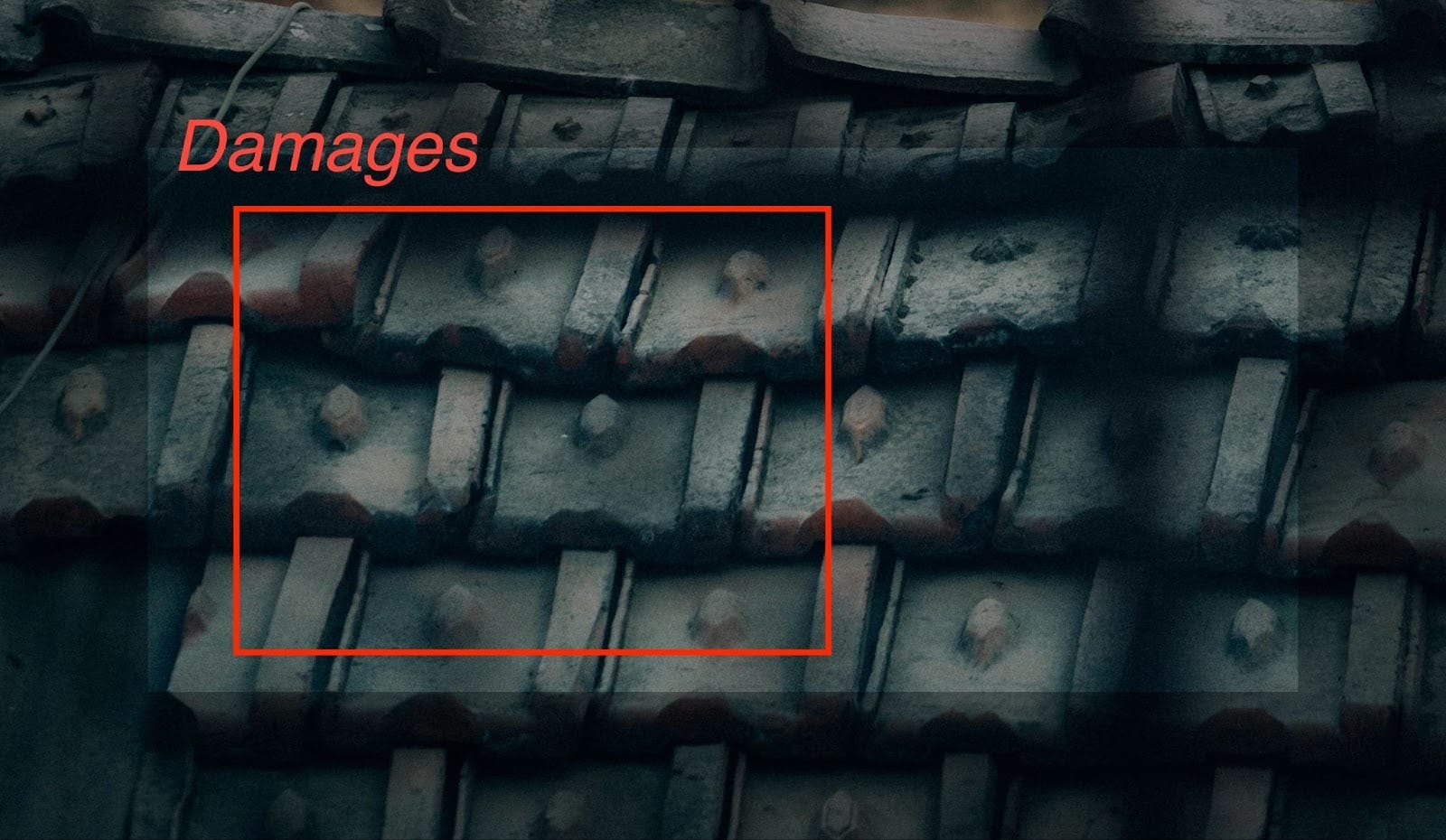
Computer vision models, which enable the analysis of diverse image data, have been a key step in bringing AI into insurance workflows. Insurers such as The Hartford have been cited as using computer vision technology to detect property characteristics such as roof condition or surrounding vegetation from aerial imagery. These systems represent an important first step in using AI to understand physical assets and assess their condition.
The Next Wave: Building Representations of How the World Behaves
Recent advances in AI have brought renewed attention to so-called “world models”. As Fei-Fei Li describes it, the field is moving “from words to worlds”, reflecting a shift toward systems that can model real-world environments and their dynamics.
In this context, computer vision represents an important foundation: enabling AI systems to interpret visual data about the physical world. World models extend this further by combining multiple data sources and capturing how conditions evolve across space and time.
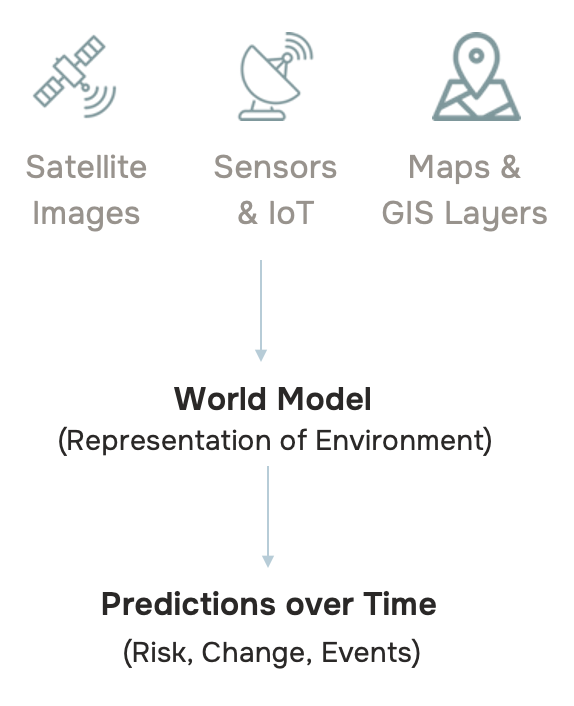
In practice, this means moving beyond models that operate on isolated inputs, toward systems that integrate multiple types of data (e.g., imagery, spatial signals, environmental data) into a coherent view of how conditions evolve.
The effectiveness of these systems is not determined by model performance alone. Before performance comes the data on which they are built, and then how they are ultimately integrated into workflows.
This shift is particularly relevant in insurance. Emerging work in actuarial science highlights that risk does not exist at a single point in space or time. It emerges from the interaction between environment, infrastructure, and events over time. Understanding it, therefore, requires more than static data. It requires understanding how conditions change and interact.
The key idea is simple: not just where something is, but what happens there, and why.
We are currently applying this approach in underwriting workflows for residential portfolios in Japan. Traditionally, this process relies on a combination of static datasets, external models, and manual analysis, often taking weeks to produce usable outputs.
By contrast, an agent-based system can combine historical development patterns from satellite imagery, seismic activity, flood and landslide exposure, and real-time weather signals into a unified representation of risk. Within minutes rather than weeks, these inputs are orchestrated into a consistent workflow, generating a property-level risk profile: a structured, explainable view of the key drivers of risk.
The difference is not only speed. It is the ability to move from fragmented analysis toward a continuously updated, decision-ready view of risk. If you would like to see how this can be applied to your own portfolio, you can book a short demo here, and we will walk you through it.
The Missing Layer: Agent-Orchestrated Systems in Operational Workflows
Many of the risks which insurers manage, from floods to wildfires to storms, are fundamentally physical phenomena.
Geospatial datasets such as satellite imagery, elevation models, and environmental indicators capture continuous signals about how the physical world behaves. These datasets do not just describe location, they reflect variation across space and change over time.
This is particularly relevant in property and casualty (P&C) insurance, where risk is directly tied to environmental exposure. More broadly, it highlights a key challenge: understanding the world is only part of the problem.
The real challenge is integrating that understanding into operational workflows. As AI systems increasingly move toward modeling how the world behaves, a gap remains between these capabilities and their use in real decision contexts.
What is required is not just a new type of model, but a system that can combine multiple data sources and produce consistent, decision-ready outputs.
This includes:
- Models that process different data modalities (text, imagery, spatial, and environmental signals).
- Agent-based workflows that orchestrate inputs, adapt methodologies to use cases, and translate the results into usable outputs.
- Integration into underwriting and operational processes.
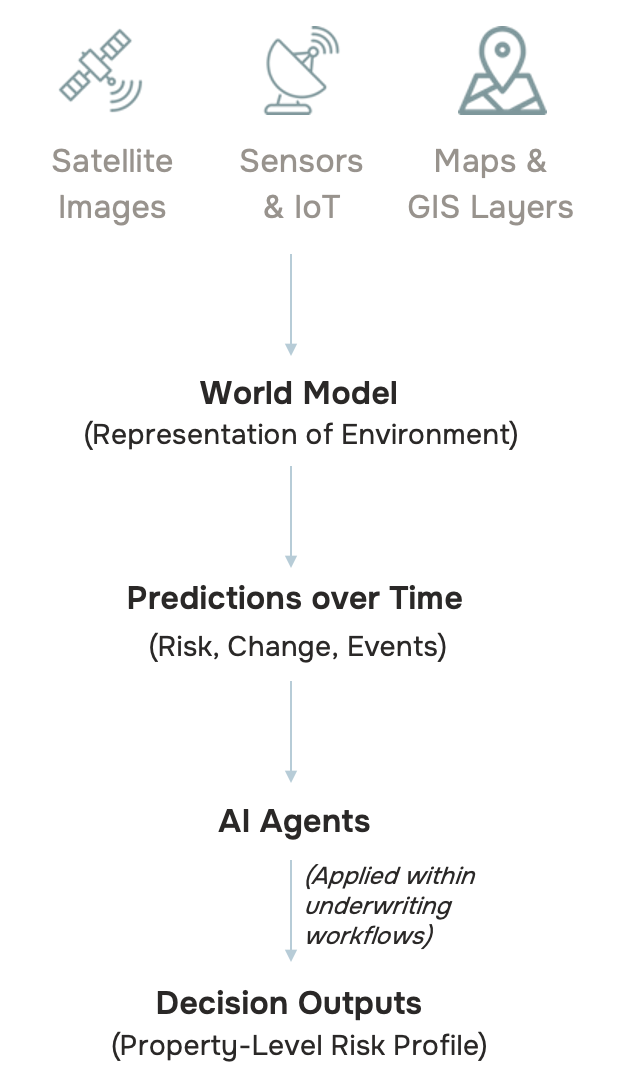
Within this structure, spatial data of various formats becomes a critical source of context. They enable AI systems to reason not just over abstract data, but over the real-world conditions that drive risk.
This is where we see the biggest opportunity: structuring systems that allow AI to operate on real-world data and integrate seamlessly into decision making workflows, in insurance and beyond.
Johanna von der Leyen is CEO and co-founder of PangeAI, a geospatial AI company that enables energy, insurance, and natural capital organizations to query the physical world in natural language. PangeAI emerged from stealth in December 2025.
Want to learn more? Reach out: hello@pangeai.com